
For traders who rely on detailed charts, flexible order management, and a clean trading interface, choosing a proprietary trading firm that supports cTrader can make a meaningful difference to the daily workflow. However, a familiar platform does not automatically mean that a challenge is suitable. The firm’s evaluation rules, trading costs, permitted strategies, and payout conditions still determine whether the account fits a particular approach.
cTrader is used for forex and CFD trading and is available across desktop, web, and mobile environments. Its features include chart-based order management, price alerts, performance analysis, and algorithmic trading tools. Depending on the application and setup, traders can also work with custom indicators and cBots.
This guide compares five prop firms that offer cTrader access, explains the platform features worth understanding, and outlines the evaluation conditions to check before paying for a challenge. The ranking is an editorial comparison based on platform relevance, program variety, and the practical questions traders should ask—not a guarantee of performance or payouts.
What makes cTrader different?
A trading platform is more than a window for buying and selling. It affects how quickly a trader can interpret price movements, place orders, manage risk, and review past decisions.
cTrader separates several useful functions into connected areas. The Trade interface handles market analysis and execution, Copy supports strategy copying, Algo provides algorithmic tools, and Analyze helps users review performance and account statistics. Availability of individual features can vary by device and configuration.
Chart-based trading and order management
One of cTrader’s practical strengths is the ability to interact with trades directly from a chart. Traders can place market and pending orders, adjust stop-loss and take-profit levels, and manage open positions without relying exclusively on a separate order ticket.
For an intraday trader, this can simplify the process of adjusting a position after a breakout or changing a protective stop as market conditions evolve. Multiple take-profit levels can also support a planned approach to scaling out of a trade.
The convenience does not replace risk management. A stop order may be affected by slippage during fast markets, and the availability of a particular order type does not override the prop firm’s rules.
Technical analysis and customizable charts
cTrader offers chart layouts, indicators, drawing tools, chart templates, and multiple timeframes. Traders can arrange the workspace around their own process, whether they monitor a small number of currency pairs or track several instruments at once.
This flexibility is useful when the same analysis routine needs to be applied consistently across evaluation and funded-style account stages. A stable workspace can reduce operational mistakes, although it cannot guarantee better entries or profitable results.
Before selecting a challenge, confirm that the instruments you trade are available through the firm’s cTrader environment. Platform support alone does not guarantee that every symbol offered by a company is accessible on every account.
Price alerts and trade monitoring
Price alerts help traders monitor important levels without watching every chart continuously. An alert can be placed around a breakout level, a support zone, or a price that would invalidate a planned setup.
cTrader also provides account and transaction information that can help traders review activity. These tools are particularly useful when the evaluation includes strict daily loss limits, because traders need to understand how their open positions and realized results affect account equity.
Alerts are not substitutes for monitoring the account itself. A trader remains responsible for following the firm’s risk rules and managing positions during volatile conditions.
cBots and algorithmic trading
cTrader Algo supports automated trading tools known as cBots, as well as custom indicators. Depending on the application, algorithms may be developed, managed, and run locally or through supported cloud features.
This can appeal to systematic traders who use predefined entry conditions, automated position management, or repeatable execution routines. However, there is an important distinction between what the platform can do and what a prop firm permits.
Some firms restrict particular automated strategies, third-party tools, latency arbitrage, high-frequency trading, or trade copying. Others allow automation subject to conditions. Always check the firm’s current prohibited-strategy policy before connecting a cBot to an evaluation account.
Five cTrader prop firms compared
The following firms provide a starting point for traders researching cTrader-enabled evaluation programs. Challenge availability, prices, account sizes, and platform conditions can change, so the exact product should be verified before purchase.
| # | Prop Firm | Best For | Markets | Challenge Types | Editorial Rating |
|---|---|---|---|---|---|
| 1 | FTMO | Traders seeking established CFD evaluation options | Forex and other CFDs, depending on the account | Multiple evaluation structures | 4.8/5 |
| 2 | The5ers | Forex-focused traders comparing different program structures | Forex and additional CFDs, depending on the program | Multiple program models | 4.6/5 |
| 3 | FundingPips | Traders comparing different CFD challenge formats | Forex and other supported CFDs | Multiple challenge models | 4.5/5 |
| 4 | FundedNext | Traders who want to compare several account and evaluation options | CFDs and other products under separate program rules | Multiple models, with platform-specific conditions | 4.4/5 |
| 5 | Leofins | Multi-asset CFD traders who want cTrader as a platform option | Forex, crypto, indices, metals, energies, and shares | Core 2-Step, Edge 1-Step, and Starter 3-Step | 4.3/5 |
Editorial ratings are comparative judgments for this article, not independently audited performance scores, payout probabilities, or customer-satisfaction statistics.
1. FTMO: For traders comparing established evaluation structures
FTMO offers cTrader among its supported platform options for eligible trading accounts. It is worth examining for traders who want to compare evaluation structures while using a platform with chart-based order management and a broad set of analysis tools.
The key consideration is whether the specific FTMO product you intend to purchase supports cTrader and the instruments you need. A firm may offer more than one account type, and its rules should be read in the context of the selected product rather than treated as universal.
What to evaluate
Start with the challenge’s profit target, daily loss limit, and maximum loss calculation. These conditions define the boundaries within which the strategy must operate. A trader whose approach uses several simultaneous positions should understand whether drawdown is measured using balance, equity, or another stated method.
Then compare the payout schedule, reward split, and any conditions that apply after passing the evaluation. Passing a challenge does not necessarily mean that a reward can be withdrawn immediately.
For cTrader users, the final checks should include the supported instruments, the available account features, and any restrictions on automated trading. If you rely on cBots, do not assume that all algorithms are permitted simply because the platform supports them.
Potential fit: Traders who want to compare evaluation options and prefer cTrader’s charting and trade-management workflow.
Check carefully: The selected account’s platform availability, current challenge rules, and prohibited-strategy policy.
2. The5ers: For traders prioritizing forex-oriented strategies
The5ers is a relevant option for forex traders comparing evaluation programs and the rules attached to each model. cTrader access should be verified for the particular program and account being considered.
Forex traders often pay close attention to the London and New York sessions, currency-pair spreads, overnight holding, and scheduled economic announcements. A program that looks attractive on the basis of its advertised account size may be unsuitable if its trading conditions conflict with those habits.
Why evaluation rules matter
A swing trader might hold positions through several sessions, while a scalper may open and close trades within minutes. The same evaluation can affect these strategies differently depending on news restrictions, minimum holding times, weekend rules, and daily loss calculations.
Before paying, confirm whether the program allows the holding periods and trading techniques your strategy requires. Review the terms for automated tools as well if you use indicators or cBots to generate or manage trades.
cTrader can help organize chart analysis and position management, but it cannot compensate for a mismatch between the program rules and your trading method.
Potential fit: Forex-focused traders who want to compare program structures and use a modern chart-based trading interface.
Check carefully: Current cTrader availability, eligible instruments, overnight rules, and the conditions that apply after evaluation.
3. FundingPips: For traders comparing different CFD challenge formats
FundingPips offers cTrader as one of its platform options for eligible products. Its range of challenge models makes it important to identify the exact account type before comparing fees and evaluation requirements.
The platform itself may remain familiar across different trading environments, but challenge conditions can differ substantially. Profit targets, loss limits, payout eligibility, and other restrictions should be checked for the selected model.
The platform questions to ask
If you trade manually, examine the chart tools, order controls, and alerts you use most often. If you rely on automation, check the firm’s rules for cBots, third-party tools, and any restricted execution methods.
Also consider whether the evaluation is compatible with your usual trading frequency. A strategy designed to distribute returns across many modest trades may interact differently with consistency requirements than one that generates a small number of large winning days.
Do not assume that a challenge is appropriate simply because the platform is supported. The account’s risk rules should be tested against your actual approach before you pay.
Potential fit: Traders who want to compare multiple CFD evaluation formats while retaining cTrader as their preferred execution platform.
Check carefully: Model-specific restrictions, the applicable platform conditions, and the payout rules in force at purchase.
4. FundedNext: For traders comparing platform and account options
FundedNext lists cTrader among its supported platforms for eligible products. Its published platform guidance also sets out restrictions that make account selection particularly important.
For example, its current documentation states that traders must choose their platform before their first trade; once a trade has been executed, the platform is locked for that account. The same guidance identifies account-size restrictions for cTrader and Match-Trader, so traders should not assume every advertised balance is available through every platform.
FundedNext also distinguishes between trading execution and analysis. Its published guidance has identified TradingView as an analysis option rather than an execution platform during the stated period. Traders should check the latest rules rather than assume that charting integration automatically permits order placement.
What to verify before choosing
- Whether the desired challenge and account size can be opened on cTrader.
- Whether a platform fee applies.
- Whether platform switching is allowed before or after trading begins.
- Which symbols are supported for the selected product.
- How the evaluation and payout conditions differ across models.
These checks are especially important for traders who have already built their routines around a particular platform. Switching after a challenge starts may not be possible, so the initial selection deserves attention.
Potential fit: Traders who want to compare account models and understand platform limitations before choosing a challenge.
Check carefully: Current account-size restrictions, platform fees, regional eligibility, and platform-switching rules.
5. Leofins: For multi-asset CFD traders using cTrader
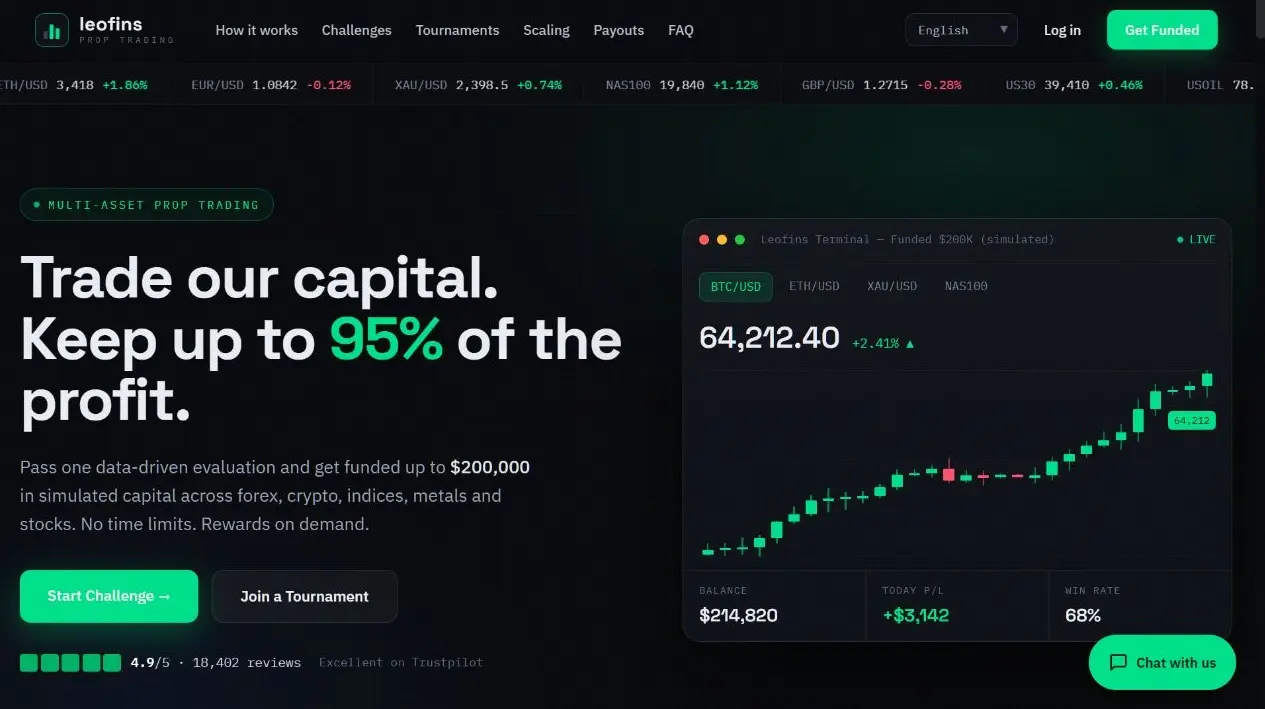 Leofins offers cTrader alongside other platform options, making it worth considering for traders who prefer to manage a range of CFD markets through a familiar interface. Its published CFD instrument selection covers forex, cryptocurrencies, indices, metals, energies, and shares.
That range can be useful for traders whose strategies vary with market conditions. One trader may focus mainly on currency pairs, while another may move between gold, equity indices, and selected share CFDs. A multi-asset offering can make that rotation convenient, provided the account rules and instrument specifications fit the strategy.
The official website, https://leofins.com, provides information about its programs, platforms, and trading conditions.
Compare the three evaluation structures
Leofins publishes three principal CFD evaluation routes:
- Core 2-Step: A two-phase evaluation with separate targets and risk limits for each phase.
- Edge 1-Step: A single-phase evaluation with its own target and drawdown structure.
- Starter 3-Step: A three-phase evaluation that spreads the assessment across more stages.
These models should not be treated as interchangeable. A single-phase challenge may have a different loss-limit structure from a two-phase program, while a three-phase evaluation requires the trader to meet the objectives at each stage.
The right choice depends on how the rules fit your trading method, not simply how many stages appear on the product page.
cTrader features and practical considerations
For a trader who uses chart-based entries, cTrader’s order controls can make it easier to set and manage protective stops and profit targets. Its price alerts can help monitor key levels, while its analysis tools can support a review of trade history and account performance.
If you use cBots, confirm both the platform’s technical requirements and Leofins’ current automation rules. Platform capability does not grant permission to use every strategy. Similarly, traders using news-driven or weekend strategies should verify the applicable rules before starting an evaluation.
Review the instrument specifications for your most frequently traded symbols, including spreads, commissions, leverage, and overnight costs where applicable. A broad market list is only valuable if the relevant instruments are available under conditions compatible with your strategy.
Potential fit: Traders who want cTrader access and a broad selection of CFD markets within different evaluation structures.
Check carefully: The chosen program’s loss limits, supported symbols, automation rules, payout requirements, and any restrictions specific to the account.
How to compare evaluation conditions fairly
Platform features are easy to demonstrate. Evaluation rules are harder to compare because firms may calculate risk and reward differently. Before buying a challenge, assess the following areas together.
Profit targets and evaluation stages
A one-step challenge generally requires the trader to meet a target in a single evaluation phase. A two-step program divides the assessment into two phases, while a three-step structure adds another stage.
The number of phases does not tell you how difficult a challenge will be. Compare the targets, minimum trading days, time limits if any, and rules for moving to the next stage. Check whether the same risk requirements apply throughout the evaluation.
Daily loss and maximum drawdown
Daily loss limits and overall drawdown rules are among the most important conditions in a prop challenge. Firms may calculate losses using balance, equity, a fixed starting value, or a trailing reference point.
Understand when the daily limit resets, whether open losses count, and what happens if the account touches the limit. A strategy that appears profitable over a long period can still violate a daily rule during a volatile session.
Trading restrictions
Check rules for news trading, holding positions over weekends, hedging, copy trading, and automated execution. These restrictions can have a direct impact on whether a strategy is usable.
A cBot that executes perfectly on a personal account may still violate a firm’s rules if its strategy is prohibited. Likewise, a trader who normally holds positions over weekends should not assume the same approach is allowed in every challenge.
Payout conditions
Read the payout terms before buying rather than waiting until after passing the evaluation. Confirm the minimum qualifying period, withdrawal schedule, consistency requirements, reward split, and any limits that apply to early payouts.
Also distinguish between a simulated evaluation account and a live brokerage account. Prop firms may operate simulated trading environments and use their own rules to determine reward eligibility. The term “funded” should not be taken to mean that every trade is executed with a conventional personal brokerage balance.
Total cost
Compare the full price at checkout, not just the headline challenge fee. Consider platform charges, reset fees, optional add-ons, and the terms for refunds if a program offers them.
A cheaper evaluation is not necessarily better value if its rules conflict with your strategy or the costs of trading the instruments you prefer are higher.
A cTrader checklist before you pay
Use this checklist to compare the platform and the challenge as one package.
Confirm that cTrader is available for the exact challenge and account size.
Check the symbols and market hours for the instruments you trade.
Review spreads, commissions, swaps, and other applicable costs.
Understand the daily loss and maximum drawdown calculations.
Check minimum trading days and any time limits.
Read the firm’s rules for news trading and weekend holding.
Confirm whether cBots, third-party tools, and copy trading are allowed.
Verify payout eligibility, reward splits, and withdrawal timing.
Save the terms that apply to your purchase.
If possible, test the platform workflow in a demo environment before committing money. Practice placing orders, adjusting stops, checking position sizes, and reviewing trade history. This helps identify operational problems before evaluation rules are at stake.
Frequently asked questions
Is cTrader better than MetaTrader for prop trading?
Neither platform is automatically better for every trader. cTrader offers chart-based trading controls, customizable layouts, performance analysis, and algorithmic tools. MetaTrader platforms have their own workflows and established ecosystems. The better option is the one that supports your strategy, tools, and the specific prop firm’s rules.
Do all prop firms that advertise cTrader allow automated trading?
No. cTrader supports cBots, but the firm’s own terms determine which automated strategies are permitted. Check for restrictions on third-party algorithms, high-frequency trading, latency arbitrage, trade copying, and other prohibited methods.
Can I change my platform after starting a challenge?
That depends on the firm. Some providers lock the platform after the first trade, while others have different switching policies. Confirm the rule before opening the account, especially if you plan to use cTrader for the entire evaluation.
Does cTrader guarantee faster execution?
No platform can guarantee a particular result for every order. Execution depends on the account environment, server and network conditions, liquidity, and the provider’s setup. Platform features should be assessed alongside the firm’s actual trading conditions.
Can I use cTrader on mobile?
Yes. cTrader has mobile applications as well as desktop and web versions. However, specific algorithm-development and management functions may differ between applications. Confirm which features are available on the device you intend to use.
What is the most important evaluation rule to check?
Start with the daily loss limit and maximum drawdown calculation. These rules determine how much adverse movement the account can tolerate. Then examine profit targets, consistency requirements, trading restrictions, and payout conditions.
Make the platform and rules work together
cTrader can provide a capable environment for chart analysis, order management, alerts, and algorithmic trading. But a prop firm should be selected on more than platform availability. The evaluation structure, risk limits, permitted strategies, instrument costs, and payout rules must all fit the trader’s approach.
FTMO, The5ers, FundingPips, FundedNext, and Leofins offer different options for traders comparing cTrader-enabled programs. Their suitability depends on the exact account and current conditions. Confirm platform access for the chosen challenge, read the firm’s rules, and avoid paying for an evaluation until you understand how the account will be assessed.
Prices and conditions are current as of October 2026.
Risk disclaimer: Proprietary trading evaluations involve financial risk. Challenge fees may be lost if an evaluation is unsuccessful or program rules are breached. Simulated trading and funded-program results do not guarantee future performance or income. Review the current terms carefully and never spend money you cannot afford to lose.